



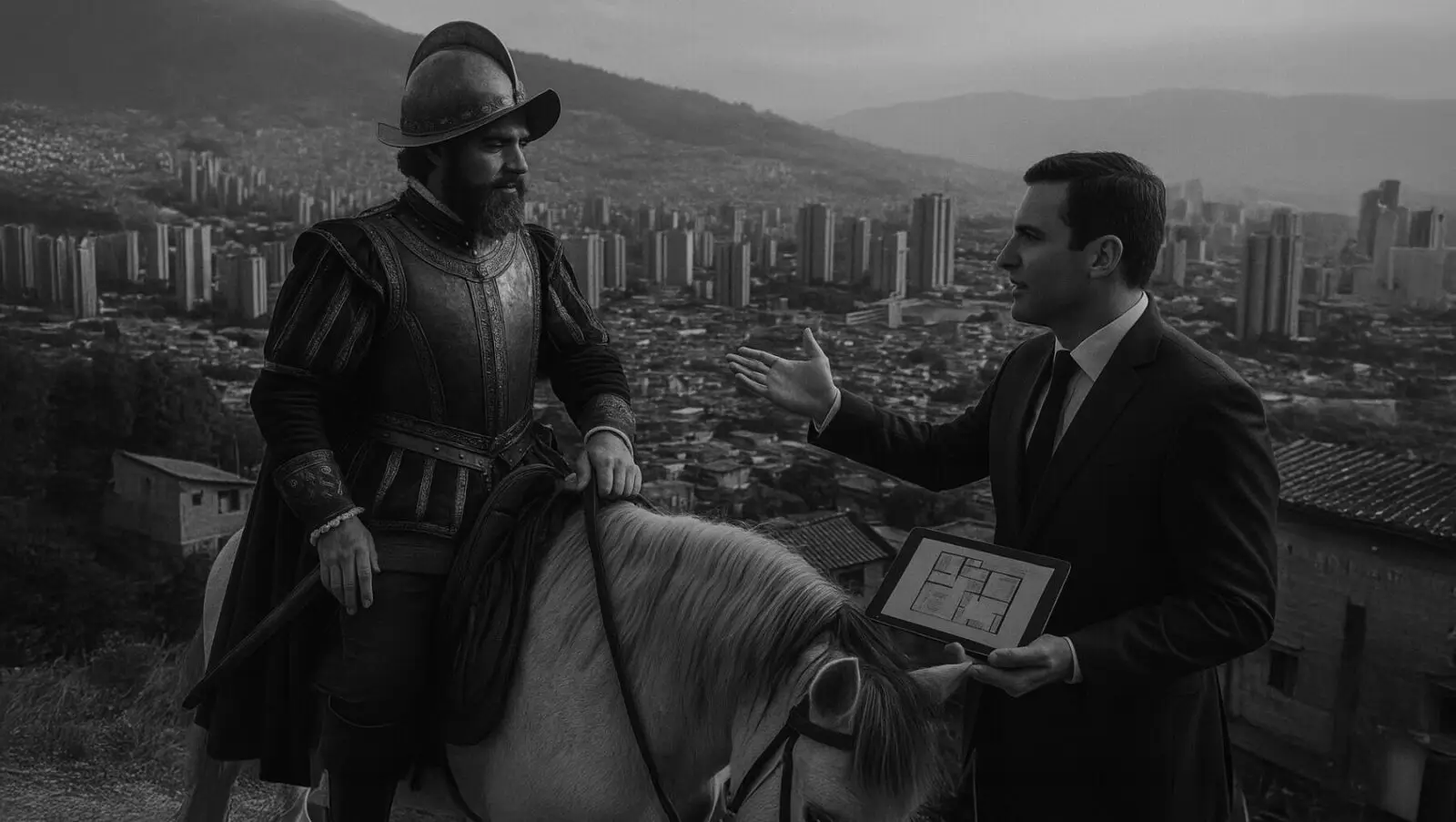
"Gentrification" in Medellín: victims of change or witnesses of progress?
 Alejandro Gonzalez UribeMay 28, 20256 Mins read
When arriving in Medellín becomes a sin
Today, Medellín is on everyone's lips: tourists, digital nomads, investors, and, of course, critics of gentrification. Social media is flooded with complaints about rising rents, the “loss of identity” of traditional neighborhoods, and the supposed foreign invasion. The narrative seems clear: there are those who arrive and those who lose out. But is it really that simple?
The problem with this narrative is that it ignores the fundamental fact: the history of humanity is, in essence, the history of gentrification. From the earliest settlements to large metropolises, humans have migrated to places with better living conditions, transforming the environment in the process. What we call gentrification today is nothing more than a contemporary version of a millennia-old dynamic.
The world was not created last year. Cities, territories, and cultures have been changing for centuries because their inhabitants change. That change is not a deviation from the path: it is the path itself.
The history of Medellín is the history of gentrification.
Some people ask: when did this transformation begin? With the digital nomads of 2020? With the tourism boom? With the construction of Provenza as the epicenter of nightlife? No. Medellín began to transform itself when it was a parcel of land divided up by its former owners. Before Comuna 13 was turned into a tourist attraction, Medellín experienced rural displacement, forced urbanization, industrial development, and yes, land deals.
And if we go further back, we could say that it all began 500 years ago, when we traded gold for mirrors. But even that is recent in the timeline of humanity. The history of America, like that of Europe, Asia, or Africa, is the history of exchange, conquest, trade, and constant transformation.
Medellín was no exception. It was a divided territory, then a colonial town, later an industrial center, and today a global city. Before that, it was indigenous territory. And before that, part of a continent that no one even knew existed. The Spaniards who arrived here came from a country that was neither pure nor static: Spain was built on layers of Greeks, Romans, Visigoths, Arabs, and Christians, each leaving their mark, displacing, mixing, and appropriating.
It has always been this way. What we now call “gentrification” is nothing more than the latest iteration of an ancient human phenomenon. The thing is that right now, after millennia of the same thing, we feel that it is affecting us in our own homes. Did we really think that the world would freeze just when we arrived? Societies have never been static. To believe that we could live forever under the same conditions is to ignore the fact that the history of humanity is one of constant change, progress, conquests, and adaptations.
Absolute stability is a fiction; transformation has always been the norm.
Touristification: the new convenient enemy
It has become easy to blame tourists. The blond guy with an American accent who pays in dollars, or the “new rich” who buys an apartment to rent out on Airbnb. Visitors are blamed for prices, for crowding trendy bars, or even for the aesthetic commercialization of poverty. But rarely is mention made of the locals who sold, rented, promoted, or decided to profit from that same process. And this is not a recent phenomenon: from the first colonial encomiendas to the land sales of the 19th century, the inhabitants themselves—or those who had access to power—were active players in the transformations of the territory.
Local elites have historically been partners with foreign capital. Every cycle of expansion in Medellín, from industrialization to the current digital economy, has involved internal participation that validated, facilitated, or even drove that change. To ignore that role is to erase half of our history.
There is no gentrification without transaction. No one expropriates anyone. What exists are simple market dynamics. And yes, there are social consequences that must be discussed, but not from a place of resentment or nostalgia for a past that was never perfect.
Medellín's development is also the result of free trade, openness to the world, and competition to improve. From its beginnings as a colonial town to its current role as an investment destination, the city has prospered precisely because it has been able to integrate itself into broader flows of capital, migration, and technology.
In the 19th century, European engineers brought with them the first modern sewerage systems. The first electric tram, inaugurated in 1921, was also a symbol of a Medellín that looked outward to move forward. Foreign knowledge and capital not only built infrastructure: they also brought educational, industrial, and urban models that helped turn the city into a dynamic center.
Like other cities around the world, Medellín has grown not by resisting change, but by adapting to it, incorporating the new without having to give up its essence. Each wave of progress—from coffee to software—has been made possible by this willingness to open up and compete. In this sense, urban evolution is not a threat, but a reflection of a living city that does not fear the future.
New York, Miami, and now Medellín: the natural law of urban growth
The example is clear: the United States was built on the principle that anyone can come and prosper. That wasn't gentrification: it was growth. New York isn't what it is because it protected its first inhabitants, but because it allowed millions to come and change it. Miami has been transformed by the arrival of Latinos who, in many cases, displaced others. No one calls it touristification: they call it progress.
And this dynamic is not unique to the modern Western hemisphere. From the expansion of Rome, which absorbed and transformed entire territories under its urban and commercial model, to the rise of cities such as Paris and London after centuries of internal and external migration, the pattern is the same: vibrant cities are those that welcome, adapt, and reinvent themselves. There is no urban history without displacement, without friction, without change. Medellín is simply going through a contemporary version of that same process.
To pretend that Medellín is the exception to this logic is naive. The real debate should be how to include more people in this progress, not how to prevent others from participating in it. Because when a place improves, it is natural that more people want to live there. That is not a crisis: it is a sign of success.
What should concern us is the lack of historical memory. We don't understand what we are experiencing because we don't know where we come from. If we studied the history of cities, we would see that each stage of transformation represents an opportunity. And that opportunity is seized not by lamenting change, but by preparing for it. We lack civic education, but above all, historical education. Not to resist change, but to understand how to embrace it intelligently. Gentrification is not fought with speeches: it is responded to with action, with preparation, with vision.
We complain when they arrive, but we do the same thing when we leave.
And if we want to talk about consistency, let's take a look in the mirror. Tens of thousands of Colombians emigrate every year in search of a better life. They enter labor markets, rent homes, drive up prices, and transform customs. That, by definition, is gentrification in other countries. But there, we call it “getting ahead.” Here, we call it “invasion.”.
I speak from experience. I lived in Sydney, Australia, where I studied and later worked as a marketing director for a local company. I held a position that could easily have gone to an Australian. I lived in a well-located house in a neighborhood undergoing transformation. That is also gentrification. I was part of that process, as are so many migrants in cities around the world. Not with guilt, but with clarity: you go where you can build a better life, and that has always been the case.
Criticizing the arrival of foreigners in Medellín without acknowledging that we do the same when we cross the border is to close our eyes to global reality. Human mobility and the desire to prosper know no borders or ideological contradictions. What changes is the narrative, not the phenomenon.
The double standard is evident. Rejecting what we do elsewhere when someone else does it here is not defending justice: it is hypocrisy disguised as localism. If we want Medellín to grow, we must understand that this growth will attract new actors, new cultures, and new investments. Denying this is a conservative fantasy. What is truly progressive is allowing this transformation to run its course.
This is not the first time this has happened in the world, but it is the first time it has happened to us. The reaction of fear is understandable: it stems from ignorance. No one is afraid when they know what to do. Therefore, rather than rejecting the phenomenon, we should learn to navigate it. Let's educate ourselves, understand the historic moment we are living in, and take advantage of this wave instead of staying on the shore complaining. Cities do not stop; what we can decide is whether to participate in their evolution or become their spectators.
Alejandro Gonzalez
Founder of Blackroom



Related Articles

Labor reform in Colombia: the silent blow to the hotel industry
Introduction The hotel industry, by its nature, operates without pause, attending to...
Alejandro Gonzalez UribeMay 28, 2025 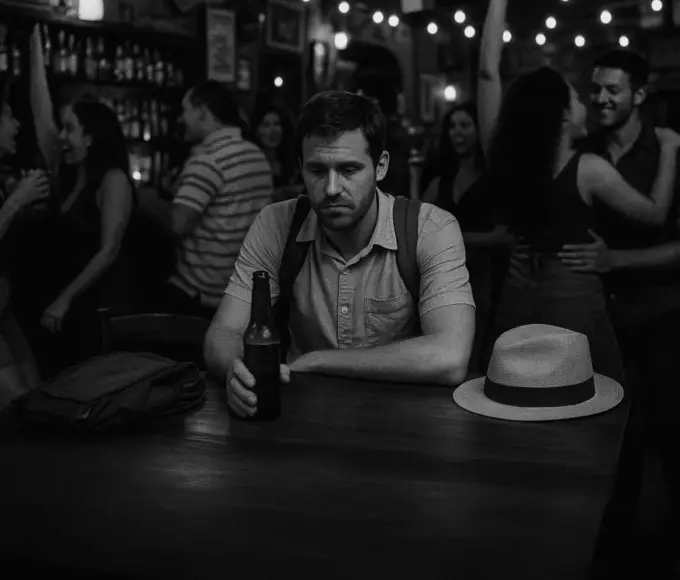
Why does Medellín seem to settle for being a cheap destination?
Today I read a news article in El Colombiano about “The top 10...
Alejandro Gonzalez UribeMay 27, 2025 
200 million dollars from Tourism for Medellin in 2024: An Engine for the Local Economy
Introduction Medellin has emerged as a hot spot for tourism, capturing more than...
 blackroom.com.coApril 24, 2024


Colombia Shines on the World Stage: A Destination of Inclusion and Opportunities in the Hospitality Industry
Introduction In a world increasingly aware of the importance of...
Alejandro Gonzalez UribeJanuary 26, 2024 