




Figures without context: the most common mistake when reading about tourism
 Alejandro Gonzalez UribeMay 30, 20254 Mins read
Did you see the graph of The Weather This week?
Every time I see news like this, I feel that by sounding positive, they avoid saying what is correct: talking about a ‘record year’ when in real terms there is a decline is not right.
If you haven't seen it, here it is. The Weather published the news that: “Tourism in Colombia could contribute more than $21 billion to the economy by 2025.”. But what that headline fails to mention is that this growth compared to 2024 is only 1.91%, which is a deeply misleading figure if it is not adjusted for inflation or compared to the exchange rate of the dollar against the Colombian peso.
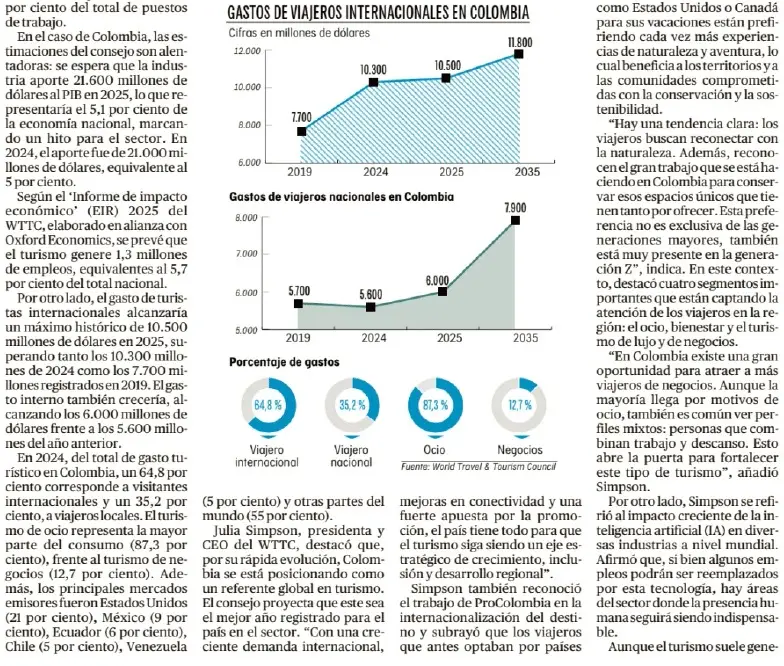
Although the graph in the news article shows international and domestic travel spending separately, what really matters is the message conveyed by the headline: that we are facing a major economic achievement. The thing is, that figure does not take into account inflation, exchange rates, or increased operating costs.
You see these headlines and understand why many people are left with the impression that everything is going well. But the reality is that we are looking at a number that, without context, sounds better than it actually is.
Why? Because if we look at the figures in the graph regarding traveler spending, that growth compared to 2024 (15.9 billion dollars combining domestic and international) is barely 3.7% nominal in dollars. In Colombian pesos, nominal growth is 7.36%, but when adjusted for inflation (4%, being conservative and using the expected inflation figure for 2025), real growth would be only 3,23%. And when you factor in the increase in costs, that very positive number begins to fade.
Are we lying to ourselves?
When talking about tourism as an economic driver, the analysis cannot be divided. While some celebrate the fact that international spending has risen to 10.5 billion and domestic spending to 6 billion, the truth is that the real growth is marginal.
Although some headlines mention that tourism will contribute more than $21.6 billion to GDP, It is worth clarifying that this figure comes from the World Travel & Tourism Council (WTTC) and represents the total impact of tourism: it includes direct spending by travelers, but also the indirect effect (suppliers in the sector) and induced effect (consumption by those who live off tourism).
Furthermore, these studies are expressed in constant dollars, which are not adjusted for domestic inflation or the local exchange rate, so the data may sound more optimistic than it actually is in economic terms for Colombian entrepreneurs.
Now, let's look at the data objectively:
| Year | Total expenditure (USD) | Average dollar | Total in COP (estimated) | Projected inflation | Growth |
|---|---|---|---|---|---|
| 2024 | 15.9 billion | $4.071 COP | $64.732 billion | — | — |
| 2025 | 16.5 billion | $4.212 COP | $69.504 billion | 4% | 3,23% in real terms |
There is moderate growth, but it is far from a figure that justifies such enthusiastic headlines. There is more money, yes, but there is also more spending. And that changes the entire analysis.
Is it possible to bill more and still earn less?
That is the real risk facing the Colombian tourism industry today.
Although in pesos the real growth is 3.23%, that will not change the life of any entrepreneur or any business. It is a marginal increase, especially when operating costs have risen on almost all fronts. The rise in fuel prices has made transportation and logistics more expensive. Many inputs are more expensive, and the risk of ongoing labor or tax reforms could put even more pressure on companies in the sector.
It's not about how much you bill, but how much you have left at the end of the day.
That is why talking about this spectacular figure in tourism revenue without mentioning profitability is simply misleading.
What needs to be done? What is in the hands of companies
At Blackroom, we are clear about one thing: Colombia—and Medellín in particular—continues to be an incredible tourist destination. And although the market is becoming more sophisticated and the challenges are growing, this is not a bad time. But it is one that requires a cool head.
It's not about slowing down or going into savings mode. It's about reviewing every line of the budget, understanding which products or services really generate profit, and making the most of each season. Instead of pursuing occupancy without a strategy, the focus should be on optimizing rates, improving processes, and seeking efficiencies.
The market is still alive. Tourism is not declining, but it is demanding more discernment. And that is where companies that know their numbers well will have an advantage.
Sometimes you see headlines that sound spectacular, but if you don't analyze them carefully, they can hide what really matters: how much is left, how much it costs, and whether we are really better off or just working harder for the same thing.
Conclusion: not everything that glitters in a headline is gold.
I want to make it clear that tourism is not in crisis, but it is entering a stage where it is no longer enough to just skim the numbers. We need to look beyond the headlines, understand the context, and adjust.
This opinion column is not intended to alarm you, far from it. It is intended to invite those of us who like to read about these issues—and those who communicate with figures—to do our homework properly and understand the full picture.
Because in increasingly sophisticated markets, you have to read beyond the headlines.






Related Articles

We are ranked 101st in TripAdvisor's list of the world's best hotels
To start this article, I’d like you to think about the last time...
 blackroom.com.coJune 11, 2026
The perfect storm in Medellín's hotel industry
I want to start this column by stating the obvious; that in every business...
blackroom.com.coMay 7, 2026 
The Medellín airport is finally going to be expanded... What now?
If you've been reading my articles for a while, you know that lately (on the contrary...
blackroom.com.coMarch 28, 2026 


The mistake no one wants to admit: Medellin builds more hotels than it can fill
What “El Colombiano” fails to see Today I read the column...
Alejandro Gonzalez UribeFebruary 12, 2026 